
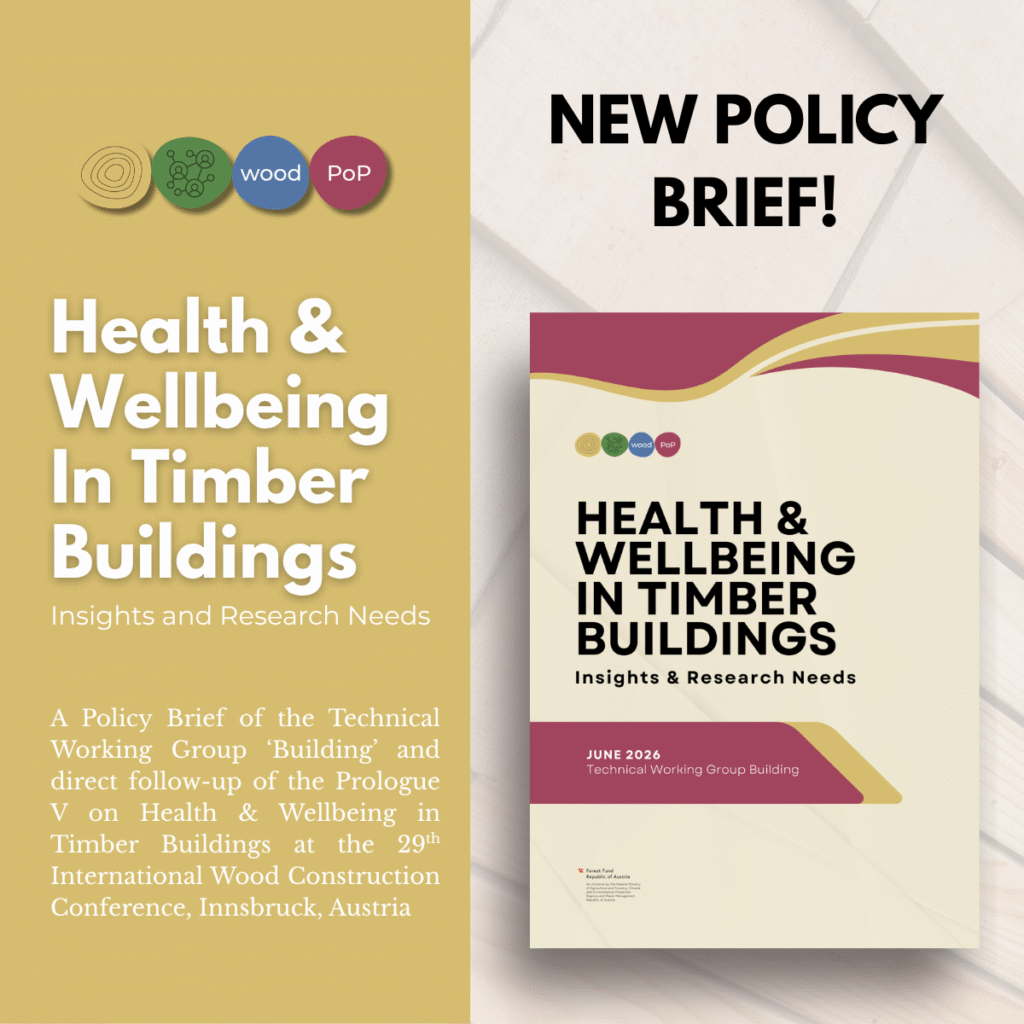
Health and Wellbeing in Timber Buildings
The Technical Working Group ‘Building’ of the European Wood Policy Platform (WoodPoP) has published a new Policy Brief on Health and Well-Being in Timber Buildings. The brief, which follows the workshop ‘Health and Well-being in Timber Buildings’ held at the 29th International Wood Construction Conference in Innsbruck on 3 December 2025, summarises the current state of research in this field and sets out the steps needed to develop more robust scientific evidence.
What The Research Tells Us
People in urbanised regions spend approximately 85 per cent of their time indoors, making indoor environmental quality a critical factor for health and well-being. Research conducted over more than 25 years, across Europe, North America, and East Asia, has consistently found promising relationships between exposure to wood indoors and a range of psychological and physiological benefits, including reduced stress responses, improved mood, and enhanced cognitive function. The use of wood indoors also aligns with design approaches such as biophilic design and with broader EU policy initiatives including the New European Bauhaus (NEB).
Nonetheless, the existing evidence base remains limited. Studies have generally relied on small and homogenous sample sizes, laboratory settings, and short exposure periods. Greater interdisciplinary collaboration between wood scientists, health researchers, designers, and building experts is needed to address these gaps.
Key Messages
- Current research shows promising results that indoor wood use contributes to a variety of psychological and physiological benefits, as well as comfort through wood’s relationship with moisture.
- Wood use indoors fits well with current policy initiatives such as the New European Bauhaus and the Clean Industrial Deal, amongst others.
- Significantly more research is needed to validate existing findings. Various measures can improve the quality of future studies.
- Access to research funding is a key limitation to conducting larger, more robust studies in real environments, and to fostering greater interdisciplinary and international cooperation.
Closing The Gap
The brief identifies several priorities, which include methodological improvements to research design and reporting, expanded multisensory investigations, and longer-term studies conducted in real environments such as offices, care facilities, schools, and residential buildings rather than laboratory settings.
The brief also highlights the need for stronger policy and funding support. Whilst national-level funding opportunities exist, support across the EU remains uneven, and existing EU funding mechanisms, such as those under Horizon Europe, offer only limited scope for this interdisciplinary field of research, while others, like the calls within the NEB show promise. Policy initiatives that set measurable health and well-being targets for building design could serve as an important driver, linking environmental sustainability goals to tangible societal benefits.
Access the Policy Brief here: https://woodpop.eu/projects/health-and-wellbeing-in-timber-buildings